|
In July 1911, a young Italian artist named Giorgio de Chirico made
his way to Paris, to seek his fame and fortune. During the next
eight years, he was to become one of the most influential painters
of the Twentieth Century. His art, which was later called
"Metaphysical", was to profoundly influence
Magic Realists, Surrealists, and Fantastic Realists for
many generations to come.
The young de Chirico, born in Greece, moved to Munich in 1906,
where he studied art at the Academy of Fine Arts. There he
studied the philosophies of both Nietzsche and Schopenhauer. He was
initially attracted to the paintings of
Arnold Boecklin. In 1908 he moved with
his family to Italy where he found the inspiration for many of his
early paintings in the piazzas of Florence, Turin and other Italian cities.
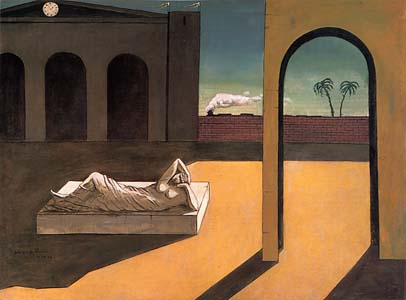
Called the "Enigma" series, these paintings portrayed dreamlike, moody and
mysterious cityscapes.
Metaphysics in the traditional sense referred to man's understanding
of his existence and the nature of physical and mental being. However, de Chirico's concept of
Metaphysical art came from Nietzche, who saw the mystery of
life emanating from everyday objects. The role of the artist was
therefore to
portray the natureal chaotic or even nonsensical reality of the world. De Chirico
referred to this as an ironic form of the Metaphysical. Rather than
exploring the perceptible or natural aspects of objects, de Chirico's work
presents the phenomenal, the cryptic and the mysterious.
There were three phases in the development of de Chirico's art. The
initial "Enigma" paintings (also called Piazza d'Italia series)
included trains, ships, clocks and statues,
a highly metaphoric iconography. Gradually less obvious objects,
such as mannequins, boxes, frames, and even gloves, were incorporated
into his
compositions in an
intermediate phase. Finally,
during his military
assignment in Ferrara in 1917, de Chirico formed
Pittura Metafisica
with Carlo Carra. Paintings of this period were
typically
claustrophobic interiors filled with arcane objects, many of them
found in and around medieval Ferrara. Other artists who became
closely involved with
de Chirico and Carra during this period were
Giorgio Morandi,
Mario Sironi and
Fillipo de Pisis.
De Chirico's original vision was to fuse ancient myth with modern
pictorial techniques. Yet around 1920 he became interested in the "Return-to-Order" trend that was
sweeping through Europe. He studied the Old Masters and attempted to
reinvent himself as a classical painter. During the rest of his
career, he alternated between the academic and Metaphysical
approaches.
Metaphysical
art refers to a type of art that captures the mysterious in life.
It is less
about specific content, more about creating a mood. De Chirico compared
his approach to one of poetics as compared with prose (narrative
art). A number of artists during the twentieth century have been
inspired in the same way.
Each was interested in exploring
deep emotional reservoirs within all of us. As a group they
may be called Metarealists. Each used an individual pictorial style
derived from Realism, but then
adapted to the individual artist's Weltanschauunge (worldview).
Metarealism may be used to refer to many types of art after 1920
which were influenced by de Chirico.
In addition to those artists associated with de Chirico in Ferrara,
a number of Post World War I artists were influenced by his
Metaphysical art. Notably, the early works of
Max Ernst, Rene Magritte and
Salvador Dali derive their enigmatical tones
from seeing de Chirico's work. Each became an important
figure within the Surrealist movement. Dali's work, in particular,
adapted an atmosphere from early de Chirico. Work by many other
artists between the wars was informed by de Chirico's approach. The compositions of
Pierre Roy in France and
Edward Wadsworth in England show direct
influence from de Chirico. Also, de Chirico's brother,
Alberto Savinio, began painting in the mid
1920s, contributing fresh, invigorated Metaphysical visions.
Edward Hopper's
art may be considered to be related to Metarealism. His paintings capture the feelings of loneliness of
the Depression era. Early in his career, he was effected by his studies in Europe prior to World War I,
but he soon developed his own unique style and an American outlook. His
work shares with de Chirico the economical rendering of forms and
the use of strong, sometimes theatrical lighting. But more importantly his work shares
the brooding mood with the early Metaphysical art, in particular by
using de Chirico's major themes of mystery and melancholy.
Although he is often referred to as a Surrealist,
Paul Delvaux avoided direct associations
with the movement and remained an outsider during most of his career. He thought of himself as a
Classicist. Exposed to the art of de Chirico in the mid
1930s, he was profoundly influenced. His paintings might be considered as elaborate
mise en scène,
with
the actors and actresses (often nude) participating in dreamlike plays. Delvaux had a long and productive career, during which his art
evolved but maintained a relatively small number of themes,
mostly based in his experiences as a child and young adult .
Kay Sage, who is
usually identified with Surrealism, was greatly influenced by de
Chirico. Her fanciful landscapes are wistful and highly evocative.
The work of her husband, Yves Tanguy, referred to as biomorphic
non-representation surrealism, has the mood of Metarealism. Tanguy, who
had no formal training as a painter, became inspired when he saw
a painting by de Chirico during a visit to Paris in 1922.
Contemporary artist
Claude Lazar explores the somber side of the city of Paris. He
studied cinematic art after graduating from Fine Art school, but
returned to easel painting a few years later. His work is full of
dramatic light and shadow, which is reminiscent of the era of Film
Noir. His art also has the feel of the French Realism of the 1930s and 40s, including
Balthus, but its strongest influences come directly from
Edward Hopper.
Metarealism
might not be considered as a formal art movement, but at the very
least, it is a significant artistic current. It's roots go back to the Renaissance. Elements of the enigmatic
and the moody can be found in the art
of
Da Vinci
and of
Giorgione,
in Goya, in the
landscapes of
Caspar David Friedrich, and in many works influenced by
Symbolism. But it was de Chirico who brought it
center stage in the world of modern art.
Visit the
Metarealism Gallery
Email:
dreams@tendreams.org.
|