|
Magic Realism in art refers to
a twentieth century movement which was initiated by European artists
after World War I, and which was followed by a second phase that began in
North America a decade later. The earliest phases of Magic Realism
began around 1919 and preceded Surrealism by several years. Together the two phases spanned
approximately four decades, with residual works after
1960.
The movement actually began as a reaction to
Expressionism, Cubism, and other avant-garde movements. The first paintings
were characterized by sharply focused,
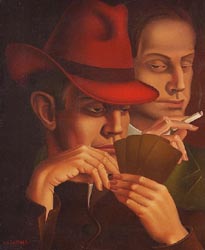 unsentimental
presentations of commonplace subject matter. The trend was
called "Post-Expressionism" by a number of writers. But the art
critic Franz Roh added the term "Magischer
Realismus" in a 1924 essay, in which he
described the leading edge of a strong current in the arts towards
a new realism .
During the same period, the
promoter Gustav Hartlaub organized a large exhibition of art in
Mannheim under the name "Neue Sachlichkeit" (translates as "New Objectivity"
or "New Functionalism"), and
it is that name that historians have generally applied to German art of the Weimar
period. unsentimental
presentations of commonplace subject matter. The trend was
called "Post-Expressionism" by a number of writers. But the art
critic Franz Roh added the term "Magischer
Realismus" in a 1924 essay, in which he
described the leading edge of a strong current in the arts towards
a new realism .
During the same period, the
promoter Gustav Hartlaub organized a large exhibition of art in
Mannheim under the name "Neue Sachlichkeit" (translates as "New Objectivity"
or "New Functionalism"), and
it is that name that historians have generally applied to German art of the Weimar
period.
Franz Roh identified 22
traits of Magic
Realism . A simplified list of these and additional information is
available by clicking here.
The important features include a sharp focus throughout the
painting, the smooth and thin application
of the paint, juxtaposition of the near and far subject matter, the
subordination of painting techniques, and the limited use of aerial
perspective and atmospheric effects. According to Roh, "the mystery
(of Magic Realism) does not descend to the represented world, but
rather hides and palpitates behind it".
There are a number of
factors that led to the development of this movement. In postwar
Germany there was a prevailing feeling of disillusionment and angst
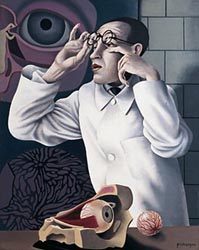 due
to instability, and stemming from the defeat in the war. The intense emotionalism
and
the experimentation of the Expressionist movement, which had dominated
the arts in
northern Europe for two decades, had run its course. Many art critics who
had previously promoted Expressionism felt that the new generation of
artists were producing superficial work, intended purely to exploit
. At the same time, many artists felt
that the Modernist movements had moved art too far in the direction of
abstraction. These same artists developed a realistic style,
portraying everyday life but adding a twist of the bizarre and
unusual. Magic Realist
painters added dreamlike and fantastic elements to their art, but their subject matter
still always remained within the realm of the possible. Herein lies
the main
difference with Surrealism, the movement that followed soon after.
Surrealism purposefully challenged us with
unreal or even unnatural imagery, although sometimes using similar techniques, borrowed
from traditional art . due
to instability, and stemming from the defeat in the war. The intense emotionalism
and
the experimentation of the Expressionist movement, which had dominated
the arts in
northern Europe for two decades, had run its course. Many art critics who
had previously promoted Expressionism felt that the new generation of
artists were producing superficial work, intended purely to exploit
. At the same time, many artists felt
that the Modernist movements had moved art too far in the direction of
abstraction. These same artists developed a realistic style,
portraying everyday life but adding a twist of the bizarre and
unusual. Magic Realist
painters added dreamlike and fantastic elements to their art, but their subject matter
still always remained within the realm of the possible. Herein lies
the main
difference with Surrealism, the movement that followed soon after.
Surrealism purposefully challenged us with
unreal or even unnatural imagery, although sometimes using similar techniques, borrowed
from traditional art .
Magic Realism spread from Germany to many other European countries, and
subsequently to North America. Although in many ways the movement was soon
overshadowed in Europe by the Surrealist movement, it flourished
to a considerable extent in the Americas, as an alternative artistic
current to the mainstream Abstract Expressionism movement which
developed in the 1940's
and 50's.
Our story continues . . .

Neue Sachlichkeit Gallery
European Magic
Realism Gallery
American Magic Realism
Gallery
Chapter 2 - Roots of Magic Realism
Chapter 3 - Neue Sachlichkeit Artists
Chapter 4 - Surrealism vs Magic Realism
Chapter 5 - Magic Realism in other European
countries
Chapter 6 - Magic Realism in the Americas
(1)
Chapter 7 - Magic Realism in the Americas (2)
Chapter 8 - Contemporary Magic Realism
Chapter 9 - Magic Realism Today
Email:
dreams@tendreams.org
|