|
The
development of Magic Realism in countries outside of Germany is
complicated by the somewhat concurrent development of Surrealism.
Some art critics and historians have failed to distinguish Magic
Realism from Expressionism on the one hand, while others
include many of its works as a part of Surrealism. Therefore a discussion of these
movements is not possible without first defining what each
of these movements represent, and how to they differ from each
other.
Surrealism was
an organized movement in both art and
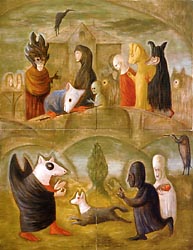 literature,
finding its impetus in "The Surrealist Manifesto", published by poet
and art critic Andr?Breton in 1924. The purpose of this art was an
approach to finds methods of uniting the conscious and
subconscious realms of experience. The world of dream and fantasy
would thus be joined with the everyday rational world in "an absolute
reality, a surreality". The Surrealists often drew from the theories of
Sigmund Freud, probing the subconscious mind as a wellspring of
imagination. The Surrealists engaged in rather spirited, sometimes
unharmonious, discussions as to how to tap the subconscious
mind and manifest it in their works. Some Surrealists were interested in
abnormal behaviors and sexuality. By contrast, the Magic Realists
tended to view the world in terms of universals, rather than through
introspection and self-analysis. They are more often observers of
society and nature, rather than explorers of swiss replica watches depths of the
subconscious mind. literature,
finding its impetus in "The Surrealist Manifesto", published by poet
and art critic Andr?Breton in 1924. The purpose of this art was an
approach to finds methods of uniting the conscious and
subconscious realms of experience. The world of dream and fantasy
would thus be joined with the everyday rational world in "an absolute
reality, a surreality". The Surrealists often drew from the theories of
Sigmund Freud, probing the subconscious mind as a wellspring of
imagination. The Surrealists engaged in rather spirited, sometimes
unharmonious, discussions as to how to tap the subconscious
mind and manifest it in their works. Some Surrealists were interested in
abnormal behaviors and sexuality. By contrast, the Magic Realists
tended to view the world in terms of universals, rather than through
introspection and self-analysis. They are more often observers of
society and nature, rather than explorers of swiss replica watches depths of the
subconscious mind.
Both Surrealism and Magic Realism use a mixture of realism and
fantastic elements. The main differences lay in the content itself.
The objective of the Magic Realist is to bring us fresh presentation of the everyday world we
live in. The artist may choose unusual points of view, mysterious
juxtapositions or common objects presented in uncanny ways. However,
everything we see is within the realm of the possible, although
sometimes unlikely. Surrealism takes us to another world, one which
is unreal and exists only in our mind. It presents the impossible,
using both traditional and experimental artistic techniques,
often shocking us.
Surrealism as a formal movement developed in Europe mainly during
the late 1920s and 1930s. A large number of painters in America
followed its development with interest, but remained independent of
the organized groups.
With the outbreak of World War II, many European Surrealists
fled to the Americas. However, they remained mostly isolated from
American artists. The most important result of these immigrations was
their influence on the development of Abstract Expressionism in the
coming years.
From the technical standpoint, the realistic effects of Magic Realism
are
achieved by a number of techniques. These include the thinning of
oil media with turpentine or by using glazes. Several artists,
including
Otto Dix and Franz
Radziwill adopted versions of the Mixed Technique, a method of oil painting
dating back to the early Renaissance. A number of
American Magic Realists used egg tempera,
a technique which dates back to the Middle Ages. Salvador Dali studied the techniques of the Old Masters
in order to master the
illusionary effects, so effective in his work. Yet most
Surrealists used more contemporary painting techniques or even experimented
with new ones, as was particularly the case with Max Ernst. In many Magic Realism
paintings the emphasis is on the enhancement of objects within the
subject matter, which helps create
compelling dynamics and to strengthen remarkable
illusions of reality.
The difficulty for many art historians in distinguishing Magic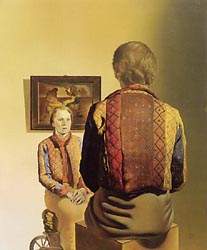 Realism from Surrealism is that so many artists tended to
cross back and forth between the two approaches. A number of
the paintings by Salvador Dali and
Rene Magritte are clearly Magic
Realism pieces. The painting to the right is
the Portrait of Gala from 1935. Dali executed a
number of paintings in the Magic Realism style during the
years of
1923-25. He also crossed between Surrealism and a faux neoclassical style,
bordering on Magic Realism,
several times later in life. Similarly the American artists
Peter Blume and O. Louis Guglielmi crossed back and forth between
approaches related to Surrealism and Magic Realism frequently during their careers.
Realism from Surrealism is that so many artists tended to
cross back and forth between the two approaches. A number of
the paintings by Salvador Dali and
Rene Magritte are clearly Magic
Realism pieces. The painting to the right is
the Portrait of Gala from 1935. Dali executed a
number of paintings in the Magic Realism style during the
years of
1923-25. He also crossed between Surrealism and a faux neoclassical style,
bordering on Magic Realism,
several times later in life. Similarly the American artists
Peter Blume and O. Louis Guglielmi crossed back and forth between
approaches related to Surrealism and Magic Realism frequently during their careers.
The inherent nature of Magic Realism art presents a major challenge
for its practitioners. Magic Realism requires that the imagery
be fresh and inventive. The artist must find ways to weave in fantastic elements, but while
still maintaining an illusion of reality. The difficulty of doing
this consistently is the main
reason that for many artists only a portion of their oeuvre ends up
being considered to be true Magic Realism, in some case only a
single painting.
Our discussion continues...

Neue Sachlichkeit Gallery
European Magic
Realism Gallery
American Magic Realism
Gallery
Magic Realism Spreads
Chapter 1 - Magic Realism Introduction
Chapter 2 - Roots of Magic Realism
Chapter 3 - Neue Sachlichkeit Artists
Chapter 5 - Magic Realism in other European
countries
Chapter 6 - Magic Realism in
the Americas (1)
Chapter 7 - Magic
Realism in the Americas (2)
Chapter 8 - Contemporary Magic Realism
Chapter 9 - The Future of Magic Realism
Email:
dreams@tendreams.org
|