Over the years, Magic Realism has been misunderstood by many and
it remains an elusive term today. In recent times, there has been
a trend to apply it imprecisely, and even gratuitously. A large
part of the problem relates to applying the term to different art
forms and in different periods. There are few cohesive links
between the two main movements, one in art and the other in
literature. And to complicate matters, recently the term Magic
Realism has also been applied to works in cinema.
From the early
1920's through the end of 1950's the term
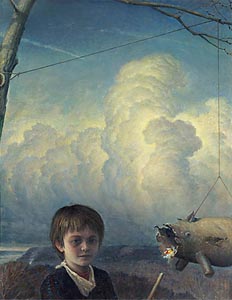 Magic
Realism was only applied to painting. It referred to Realism that
incorporated mysterious or fantastic elements, but still portrayed
everyday life. The term was applied to the work of many artists in
different areas of the world. There were countless references made
to Magic Realism by writers, art critics and art dealers during
the four decades following World War I .
Magic
Realism was only applied to painting. It referred to Realism that
incorporated mysterious or fantastic elements, but still portrayed
everyday life. The term was applied to the work of many artists in
different areas of the world. There were countless references made
to Magic Realism by writers, art critics and art dealers during
the four decades following World War I .
The term Magic Realism was only applied to literature beginning in
the 1960's. At first it was used in reference to works of Latin
American writers, such as
Gabriel Garcia Marquez, Miguel Angel Asturias, Isabel Allende and
Jorge Luis Borges. Its usage has been broadened to include works
of diverse origins and earlier periods, such as those of Ernst
Juenger, Mikhail Bulgakov and Salman Rushie. Because most of this
literature features considerable amounts of fantasy, this is a
different type of Magic Realism than the one that had been
established in art in the 1920's.
More recently, some writers have expanded Magic Realism to apply
to Motion Pictures, and there are many fine examples . These
include films like American Beauty, Big Fish, Chocolat, The Red
Violin, and Whale Rider. One of the highest grossing
foreign films was Like Water for Chocolate, based on a
Magic Realism novel. It is clear that it is easier in Cinema to
develop the complex and inextricable mixture of realism and
fantasy that makes up the fabric of effective Magic Realism .
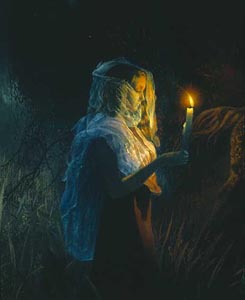 Today the term Magic Realism is developing interest that it never
commanded during the first half of the 20th century. Its place in
the history of painting is defined, although now somewhat obscured
by the passage of time. Because a different set of standards are
now used to define Magic Realism in literature, there is confusion
about what criteria apply to contemporary work. Where does one
draw the line between Magic Realism and Fantastic Realism or the
so called Imaginary Realism? It might seem appropriate to treat Magic
Realism in art in purely historical terms, rather than to attempt
to redefine it so as to be consistent with its application to
other art forms. There may be an argument that the term should be
"retired" when it is applied to painting? Still for those artists willing to research its
roots and apply its original and distinct principles to
contemporary painting, some great rewards await. The rewards of
life as a Magician.
Today the term Magic Realism is developing interest that it never
commanded during the first half of the 20th century. Its place in
the history of painting is defined, although now somewhat obscured
by the passage of time. Because a different set of standards are
now used to define Magic Realism in literature, there is confusion
about what criteria apply to contemporary work. Where does one
draw the line between Magic Realism and Fantastic Realism or the
so called Imaginary Realism? It might seem appropriate to treat Magic
Realism in art in purely historical terms, rather than to attempt
to redefine it so as to be consistent with its application to
other art forms. There may be an argument that the term should be
"retired" when it is applied to painting? Still for those artists willing to research its
roots and apply its original and distinct principles to
contemporary painting, some great rewards await. The rewards of
life as a Magician.